
Recent Blogs

Blog
Customer Focus Brings Green Technology to Rural Women in India
Customer-centricity means understanding people's financial needs and realities. Sistema.bio in India uses this approach to offer affordable biodigesters to rural women, leveraging carbon credits.
Blog
Financial Services Amid Crisis: Resilience and Reconstruction in Gaza and West Bank
FSPs in the West Bank & Gaza face unprecedented challenges amid the ongoing crisis, with Gaza's situation changing daily. Eventual stability will bring a flow of aid, making it crucial to support & rebuild the financial sector for future development.
Blog
Seven Insights From Samunnati on Income Diversification
In collaboration with CGAP and IDH under ABERA, Samunnati drives business innovation and gender and climate goals. Together, they've identified seven insights on income diversification for women in India, detailed in this blog.
Blog
Driving Change: Hello Tractor and ABERA
CGAP, IDH, FSD Network & FSD Kenya are working with Hello Tractor as part of ABERA, which empowers rural women in agriculture. We aim to address gender and climate challenges while strengthening Hello Tractor's business and financial service links.
Blog
Financial Inclusion 2.0: Embracing a New Outcome Agenda
Financial inclusion has a key role to play as an enabler for development outcomes and as a foundational element to improve livelihoods and build resilience in an ever more vulnerable and turbulent world.
Blog
Resilience at All Levels: From Macro-Insurance Solutions to Micro
Unless we can ensure low-income and financially excluded populations have access to insurance to help them build resilience directly at the micro-level, other efforts will be in vain.
Blog
Navigating Compound Crises: Microfinance Learnings From Lebanon
Lebanon has faced a recent string of compounding crises, crippling GDP and decimating the Lebanese currency. Al Majmoua MFI survived the freefall and offers valuable insights into the diversity of measures that can be taken in the face of crisis.
Blog
Are Climate-Related Financial Sector Policies Inclusive for All?
Climate-driven financial policies could inadvertently end up undermining financial inclusion efforts. Authorities and funders must understand the pathways through which risks could occur and the opportunities for supporting green finance effectively.
Blog
Financial Inclusion and Stability: A Balancing Act
Understanding the relationship between financial inclusion and stability is imperative for policymakers to advance both these goals and respond to shocks that threaten financial stability in ways that protect inclusion.
Blog
How Do Financial Systems Support Climate Resilience?
The third in our three-part blog series with Decodis and MSC discusses our finding that different climate events, and different phases of those events, drive different needs for financial services.
Blog
Adapting to or Just Muddling Through Climate Change?
The second blog in our series with Decodis and MSC explores our research finding that many poor households are just muddling through climate events rather than strategically adapting to long-term climate change in ways that enhance their resilience.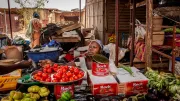
Blog
How Can Insurance Help Build a Green, Resilient & Inclusive Future?
To ensure those living in poverty benefit from emerging models in insurance, we need to focus beyond traditional risk transfer and look at broader risk management. This blog outlines three priorities for driving systems change in inclusive insurance.
Blog
Facing Climate Events in Nigeria, Farmers Left With Scarce Options
Based on interviews with hundreds of farmers in Nigeria, we unpack how households use financial services in responding to climate events.
Blog
What Does Financial Inclusion Mean for Young Women’s Well-being?
Well-implemented financial inclusion (FI) initiatives for various sub-segments of young women can produce positive financial and non-financial outcomes. Current research shows plural programs with FI components can benefit marginalized young women.
Blog
Climate Resilience Through Financial Services: Farzana’s Story
Women, especially those in low-income countries, are faced with higher risk, greater vulnerability, and fewer tools to cope with the impacts of climate change. Financial services can empower women to manage climate risks and build resilience.
Blog